Three ideas matter most: mindset — the transition from Safetoss (playing not to lose) to Mantoss (owning the map) is psychological before it is mechanical. Information — a well-timed Corsair scout is worth more than two extra Gateways. Economy — superior Probe production and continuous base acquisition win macro wars.
The Protoss Philosophy: From Safetoss to Mantoss
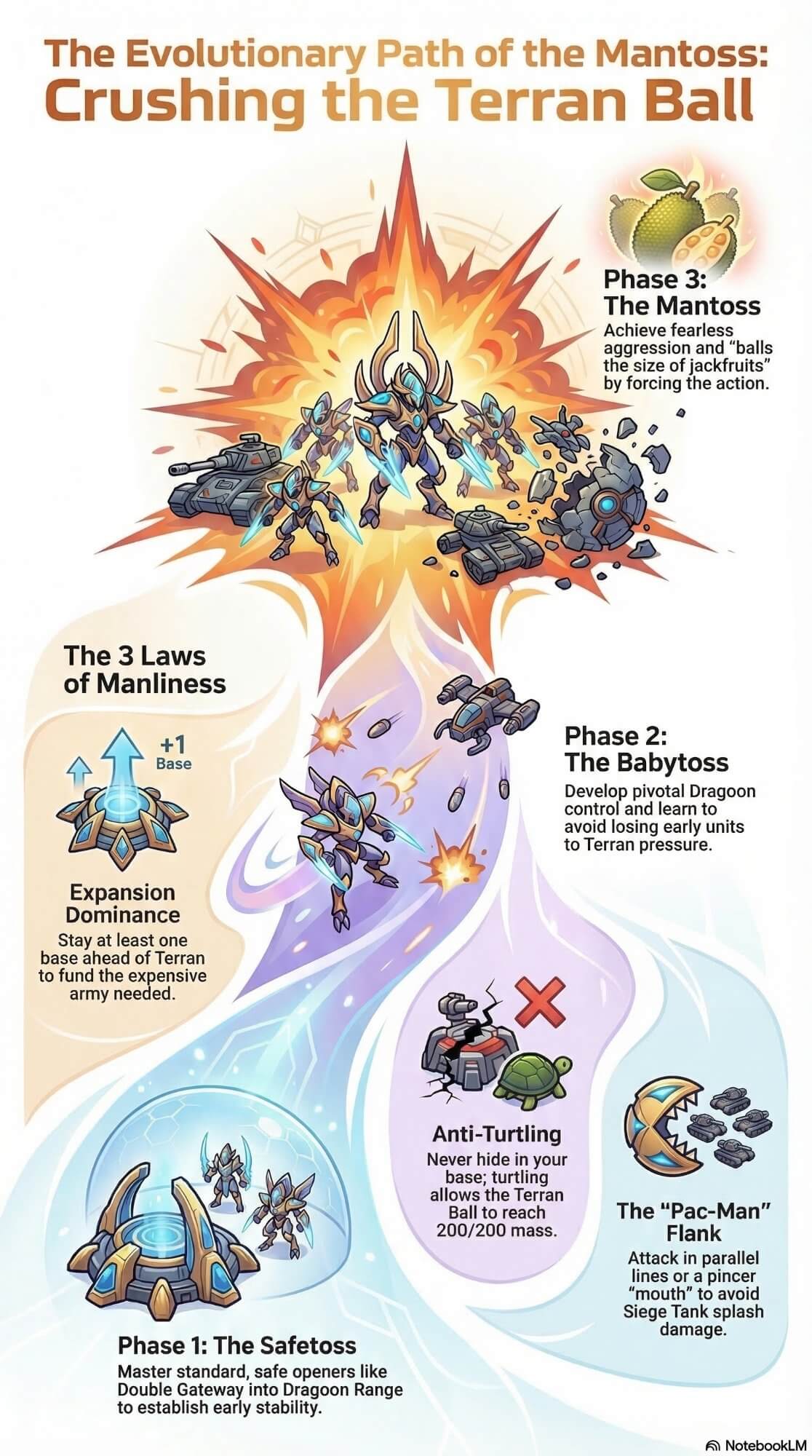
Most Protoss players start out playing scared. You sit near your natural, build up an army, and wait to react. It feels safe, but over time you fall behind. The Protoss player evolves through three distinct stages: Safetoss, Babytoss, and ultimately, Mantoss.
fearful, falling behind
aggression, still flinches
reverse imbalance mindset
ultimate objective
The Safetoss is characterised by fear — fear of the Zerg swarm, fear of the Terran siege line, fear of the tank and the mine. This playstyle is a slow death sentence. At any serious level of play, the opponent will simply out-macro you while you cower.
The Babytoss has learned aggression but still flinches. The Mantoss has internalised the "Reverse Imbalance" mindset: the deliberate, self-applied belief that the matchup is actually in your favour. In PvZ especially — widely considered the most feared matchup for Protoss — you have Archons, Reavers, High Templar, and Arbiters. Your units are individually superior. Own the map.
Not blindly attacking, but actually taking space, expanding, and forcing the game forward. A useful trick is simply assuming you can control the matchup. It changes how you move on the map.
Mechanically, the Mantoss mindset shows up in simple ways:
- Keep making Probes no matter what is happening.
- Take expansions earlier than feels comfortable.
- Use your army to create space, not just defend.
If your economy keeps growing, everything else gets easier.
Scouting = Understanding, Not Just Looking
The most transformative skill in competitive Protoss play is the ability to read the opponent’s tech tree from partial information. Scouting is not about checking their base once — it is about piecing together what they are doing from small clues.
Reading Zerg: Gas Accounting
The Corsair is the primary intelligence tool in PvZ, and its value lies not in hunting Overlords but in mineral and gas accounting. A well-timed build delivers the first Corsair at 4:20; a standard build arrives at 4:55. Those 35 seconds are the difference between knowing and guessing.
▪ Lots of Hatcheries? They probably cannot afford Mutalisks right now.
▪ Gas taken but tech missing? Something aggressive is coming soon.
▪ No Spire when there should be? Safely shift your plan away from air defence.
You are asking one question: what can they afford right now?
well-timed build
standard build
knowing and guessing
2 extra Gateways
Reading Terran: Factory Counts
PvT scouting centres on Factory count and wall status. A walled-off Terran is hiding tech; an early Observer is mandatory. The process is straightforward:
- Count Factories.
- Check if they are walled in.
- Get vision with Observers as early as possible.
Once you know what you are up against, your decisions stop being guesses.
Mid-Game Tech Paths: The Core Decision
The selection of the correct mid-game tech path is the core decision point of every Protoss game. Picking the wrong path, or committing too hard to something that gets countered, makes the game awkward fast.
The Templar Path (PvZ Pressure)
The Templar path, anchored by the Citadel and Templar Archives, is the mid-game aggression route. The +1 Speed Zealot/Corsair composition delivers a strong timing attack that controls the centre of the map until Zerg can reach Hive tech, buying time to establish a third base and transition into the macro endgame.
Pressure the Zerg. Control map space. Secure the third base. You are trying to stay active and aggressive until your macro advantage becomes overwhelming. This route hits earlier and forces more Zerg reactions.
The Robotics Path (PvT Containment Breaking)
In PvT, the Robotics Facility is the cornerstone of the match-up. Observers provide anti-drop and anti-mine detection, while Reavers provide high-splash, cliff-walking fire that no Terran player can ignore.
The Reaver/Shuttle combination is the primary tool for breaking Terran containers and containing the Terran in return. Observers keep you safe; Reavers force Terran to respect every push you make.
"If you pick the wrong path or commit too hard to something that gets countered, the game gets awkward fast." Scout first, commit second. Never invest heavily into a tech path you have not scouted the justification for.
Basic Micro That Actually Wins Games
You do not need fancy tricks — just avoid the big mistakes. The vast majority of "micro" is really just positioning before the fight starts.
The Pac-Man Mouth Formation
Never engage the Terran siege line in a single line or a clustered ball. Instead, spread units into a parallel concave — the "Pac-Man mouth" formation. Units 1A and 2A move toward their destination in parallel lines rather than a single vector.
▪ Spreads splash damage from Siege Tanks across a wider area.
▪ Envelops the Terran army from two directions simultaneously.
▪ Forces tanks to split fire between two parallel threats instead of focusing one blob.
Most fights are won or lost in the five seconds of positioning before the first shot is fired.
Late Game Is About Economy First
The endgame in high-level Protoss play is won by the player who expands most efficiently, manages gas bottlenecks most intelligently, and assembles the complete army composition before their opponent can break them. At a certain point, the game becomes less about fights and more about who manages their economy better.
Expansion Doctrine
- Always look for the next base. Expansion is never optional.
- Never stop making Probes — it is the most common mistake at every level.
- Defend your expansions properly so your army does not have to babysit them.
At every Nexus, Probe production must be continuous. The most common macro error at intermediate levels is stopping Probe production during a push. A Mantoss does not stop.
never stop
at all times
in the late game
when gas is low
Unit Cycling Through the Gas Bottleneck
As the late game progresses, gas becomes the binding constraint. High Templar and Archon production are gas-intensive; as gas depletes across your expansions, the correct response is not to wait — it is to shift production.
- When gas is low, lean more on Zealots and Cannons.
- Add expensive units (Templar, Archons, Reavers) as your gas allows.
Airborne Endgame
Carriers demand specific micro: always pre-deploy Interceptors by attacking your own buildings before the engagement. Target-fire Goliaths individually — A-moving Carriers bleeds Interceptors unnecessarily. Arbiters are used for Recall to cut off Terran production at the Factory lines, or Stasis to freeze the Tank line and allow the ground force to close the distance.
A Simple Way to Think About It
The path from Safetoss to Mantoss is not primarily a mechanical journey — it is a psychological one. Everything ties back to one question:
Are you just trying not to lose, or are you actually trying to control the game?
Every loss is a reservoir of knowledge. View the replay from your opponent’s perspective. Determine where your formation collapsed into a blob, where your expansion timing slipped, and where your Probe production ceased.
After every game: 1. Did I keep making Probes? 2. Did I take the next expansion on time? 3. Was my army creating space or just sitting at home? 4. Did I know what my opponent was doing before they did it? Every Protoss player, regardless of skill level, has to answer the same question: are you playing to survive — or are you playing to own the map?
Glossary of Tactical Terms
| Term | Definition |
|---|---|
| All-In | A highly risky strategy that sacrifices economic growth (often cutting Probes) for a decisive military strike. |
| Bulldog | A variation of the 10/15 Gateway opening against Terran used to break chokepoints. |
| ComSat Sweep | A Terran ability to reveal cloaked units; Protoss tactics involve forcing early usage to drain Terran energy. |
| Horror Gate | A highly aggressive 9/9 Proxy Gateway build popularised by Bisu to overwhelm opponents with early Zealots. |
| Leg Enhancements | An upgrade for Zealots (Speedlots) that increases movement speed, crucial for the Neo Bisu build. |
| Manner Pylon | A Pylon warped inside the opponent’s mineral line or wall-in to disrupt mining or building placement. |
| Proxy | Buildings placed outside of the main base, closer to the opponent, to speed up offensive timings. |
| Pylon Prison | Strategic Pylon placement used to trap enemy Dragoons or block movement during an early engagement. |
| Recall | An Arbiter ability that teleports a group of units to the Arbiter’s location, often used to attack the enemy’s main base directly. |
| Stasis | An Arbiter spell used to freeze enemy units, effectively removing them from a battle temporarily. |
| Wall-In | A defensive structure placement that Protoss tactics aim to bypass or prevent in PvT and PvZ. |